



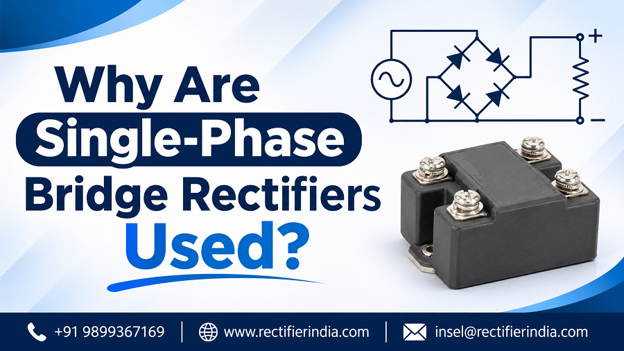
Bridge rectifiers can be found within almost all phone or laptop power supplies. This circuit will convert alternating current (AC) from the mains into direct current (DC), so that it can be used within your devices. In charger/ drive/ industrial supplies, therefore, knowledge of this type of rectifier is useful.
What is a Single-Phase Bridge Rectifier?
A Single-Phase Bridge Rectifier consists of four diodes in a diamond shape. It takes single-phase AC, typically from either domestic or small load supplies, and provides DC on its output. The main benefit of this design is the way that the diodes are shared.
How Does a Single Phase Bridge Rectifier Work?
During the positive half of the AC input, two diodes conduct, allowing current to flow through the load. During the negative half of the AC input, the other two diodes conduct. As a result, current still flows in the same direction through the load. This is a full-wave rectifier, as both halves of the AC wave are utilized.
With 50Hz AC, there will be 100 ripples per second. These can be filtered out by a capacitor to provide a more stable DC. The average voltage produced will be approximately 0.9 x input AC voltage, minus approximately 1.4 volts to account for the voltage drop across the two conducting diodes.
Why Are Single Phase Bridge Rectifiers Used?
Efficient
As both halves of the wave are utilized, efficiency is greatly increased over a half-wave rectifier. The ideal efficiency of this rectifier is approximately 81%, double that of half-wave rectifiers.
Cost and Weight Efficiency
As a center-tapped transformer is not required, cost and weight can be reduced. In addition, for a single-phase diode bridge rectifier, the maximum voltage the diodes must handle is only the peak voltage; in a half-wave rectifier, they would have to handle double the peak, so the diodes can be easily specified. There are fewer design compromises with this circuit design.
Applications
Single-phase bridge rectifiers can be found in switch-mode power supplies, charging batteries, small DC motor drives, relays/solenoids, LED drivers, and electroplating. However, in high-power systems or 3-phase systems, a different rectifier may be a better option. However, within single-phase loads, this circuit is commonly used.
How to Choose the Right Single Phase Bridge Rectifier?
Current. Choose a higher value than that required by the load. Diodes can become very hot, so it is a good idea to choose a current rating to allow for high peaks during initial switching. Voltage. Choose a voltage rating with plenty of headroom to allow for voltage spikes in the supply.
Cooling. If this rectifier is mounted on a heatsink or metal casing, then it will last for a long period of time. Otherwise, it may only last a short time. Module or Discrete. If a module is used, errors in wiring can be avoided. However, using discrete components makes it easy to replace individual diodes.
If unsure, give Insel Rectifiers the voltage, current, and duty cycle required, and they will be able to recommend a suitable single-phase bridge rectifier.
Conclusion
Single phase diode bridge rectifiers are very common due to their simplicity, efficiency and low cost. As long as there is a good margin in the ratings and good cooling, these rectifiers can last a long time. If unsure on what single phase full wave bridge rectifier to buy for your application, Insel Rectifiers make rectifiers for industrial applications, so can help you choose.
FAQ
1. How many diodes are in a Single Phase Bridge Rectifier?
Four
2. What is a single-phase diode bridge rectifier?
A rectifier consisting of 4 diodes. It converts single-phase AC to DC. Both halves of the AC are converted.
3. What is a single-phase full-wave bridge rectifier?
The same rectifier as above. The term full wave refers to the fact that both positive and negative halves of the signal are converted.
4. What are single-phase bridge rectifiers used for?
Charging, power supplies, small DC drives, relays/solenoids, LED drivers, and electroplating.
5. What are the benefits of a Single-Phase Bridge Rectifier?
More efficient than half-wave rectifiers. No requirement for centre-tapped transformers. Diodes have to deal with less voltage (only peak voltages). Simple and cheap.
6. How are Single Phase Bridge Rectifiers chosen?
Choose current and reverse voltage ratings with good margins. Consider cooling. Decide whether to use a module or discrete components. Ask the supplier for a datasheet and test data.
