
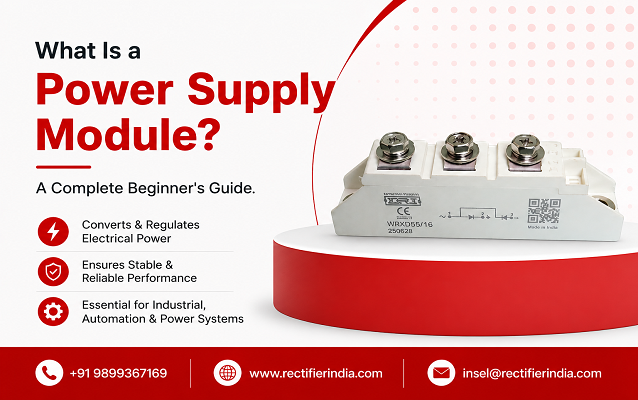
What’s the scariest kind of thing can happen in electronics?. It’s not when something’s fallen off a tower. It’s not even an antenna lighting on fire. Nope…the worst is when someone calls in saying everything’s normal, but half their site just went offline.
Then you get there and realize that some power supply module has been creeping towards failure for months in a rack no one bothers to open, quietly causing capacity to disappear long before the problem is noticed.
I think that about sums up what these things do. They ensure power doesn’t fail unexpectedly, which is why no one cares about them until they do fail.
What Is a Power Supply Module?
The electricity coming out of your wall socket is messy. The voltage constantly moves up and down as demand shifts around the grid.
Neither telecom nor medical equipment can handle being powered directly from that kind of unstable input.
That’s where a power supply module comes in. On one side you have fluctuating AC power from the grid or DC power from a battery. On the other you have whatever device needs a stable, consistent voltage to operate correctly.
Insel Rectifiers builds these as sealed units with inputs on one side and a regulated output on the other. There’s no need for additional wires soldered to the circuit board afterwards.
What’s Happening Inside
A transformer or switching circuit does the first job here, adjusting voltage up or down depending on what’s required. Rectification comes next, turning AC into DC. And then filtering knocks down the ripple, and regulation keeps the output level steady, no matter what the connected load is doing.
Switch-mode circuits have largely replaced older linear designs across industrial setups. They run cooler. They waste less power as heat. A linear supply handling the same job typically needs a bulkier heatsink, sometimes a fan too, and that’s one more part that eventually fails.
Feedback is the piece people tend to overlook. A well-designed module watches its own output nonstop and corrects itself immediately if something shifts. Skip that, and a sudden current spike downstream can knock out the entire system instead of staying contained.
The Main Types
While AC-DC modules cover the standard case, taking mains AC and turn it into regulated DC for typical industrial panels. DC-DC modules handle a different job, stepping one DC voltage to another rail entirely.
Isolated modules keep input and output electrically separate. That matters in high-voltage environments where a fault on one side absolutely shouldn’t reach the other. And the Non-isolated versions drop that separation, which makes them cheaper and smaller, fine for setups where isolation isn’t a legal requirement.
Power distribution modules get mixed up with supply modules constantly, but they’re a different thing entirely. A distribution module doesn’t regulate or generate any voltage. It just takes power that’s already been conditioned and splits it across several output points, each usually protected by its own fuse.
Applications of Power Supply Modules
Telecom sites run on these nonstops since downtime just isn’t acceptable there. Railway signaling depends on stable power even when the grid itself is misbehaving. Factory floors lean on them across PLCs and sensor networks, where even a brief voltage dip can stall an entire production run.
Solar installations need power supply modules too, bridging the gap between inconsistent panel output and the steady DC that batteries and inverters actually run on.
Tips for Choosing a Manufacturer
A spec sheet only tells part of the story. A serious power module manufacturer publishes real thermal derating curves instead of one idealized temperature figure that assumes conditions nobody actually encounters out in the field.
Push for MTBF numbers backed by field data, not lab projections alone. Ask whether custom output configurations are available too, since off-the-shelf specs don’t always match a specific panel’s requirements.
Insel Rectifiers India (IRI) has built its name on reporting field reliability honestly rather than just quoting figures off a datasheet.
Conclusion
Nobody notices a power supply module until it fails and drags something important down with it. Choosing one from a manufacturer that actually stands behind its numbers saves a lot of grief later, grief that no clever panel design can undo after the fact.
FAQs
What is a power supply module?
A hardware unit that converts incoming electrical power, AC or DC, into a stable, regulated voltage for downstream equipment.
How does a power supply module work?
Through conversion, rectification, filtering, and regulation, with the circuit adjusts output continuously as the connected load changes.
What is a power distribution module?
A device that splits an already-regulated power supply across multiple output points, typically with individual fusing or circuit protection per branch.
What is the difference between a power supply module and a power distribution module?
A supply module generates and regulates voltage from a raw input source. A distribution module doesn’t regulate anything; it just distributes power that’s already conditioned.
Where are power distribution modules used?
Telecom racks, industrial control panels, railway systems, and anywhere a single regulated source needs to feed several circuits reliably.