
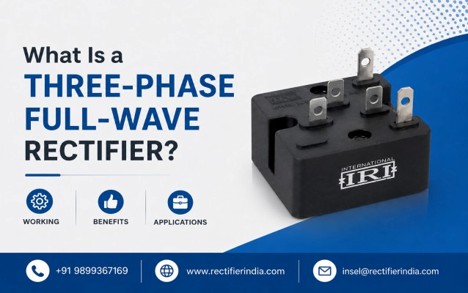
Single-phase supply runs out of steam fast once a load gets serious. A three-phase bridge rectifier takes three-phase AC and turns it into DC that heavy equipment can actually run on. Not the sagging, pulsing kind of DC. Clean output, steady enough for motors and welders and battery banks that don’t tolerate voltage dips well.
What Is a Three Phase Full Wave Rectifier?
Six diodes. That’s the number most people remember first, mostly because it’s double what a standard single-phase bridge rectifiers uses. Each phase gets its own rectification path. Three separate outputs, one merged DC line at the end. Smoother than single-phase rectification manages on a good day, and there’s a simple reason for that — at any given instant, at least one phase is actively conducting. No dead gaps.
How Does a Three-Phase Full-Wave Rectifier Work?
Three AC waveforms, offset from each other, each running through its own diode pair. Positive half goes through one diode. Negative half through the other. Because the phases overlap in time, the output basically never drops to zero the way it does in single-phase circuits between pulses.
Ripple frequency lands at six times the mains supply. Fifty hertz mains give three hundred hertz ripples. I’ve had junior engineers stare at that number and not quite register how much smaller their filter capacitors can get once ripple frequency climbs that far.
Advantages of a Three Phase Full Wave Rectifier
Smaller filter caps, first off. Less voltage droop between cycles means the capacitor isn’t doing as much heavy lifting to smooth things out. Efficiency is the bigger win long term, though. Nearly the whole AC waveform gets converted instead of thrown away in chunks. Half-wave circuits waste half the incoming power outright — three-phase full-wave doesn’t have that problem.
Heat drops too, at the same output current. Less wasted energy as heat means components run cooler, and cooler components tend to just last longer. Simple as that.
Common Industrial Applications
Motor drives are probably the biggest one. A voltage dip on a manufacturing line stalls a process, sometimes ruins a whole batch depending on what’s being made. Welders need that steady current for arc stability — inconsistent DC shows up in weld quality fast, and not in a subtle way.
Battery charging and telecom power supplies round things out. Both care about ripple more than most people assume going in.
How to Choose the Right Three-Phase Full-Wave Rectifier?
Size to peak load, not average load. Seen this mistake more times than we can count on spec sheets that had to get revised after the fact.
Thermal design matters just as much as the electrical rating. A rectifier can look perfect on paper and still fail early if the heat sink was an afterthought during design.
Certification’s worth checking too, though it usually gets the least attention of the three. Datasheet numbers get scrutinized.
Conclusion
Lower ripple. Better efficiency. Real reliability under sustained industrial load. That’s what a properly specified three-phase full-wave rectifier actually delivers, and getting the spec right only solves half the problem. The manufacturer behind the part matters just as much as the numbers on paper. Insel Rectifiers builds industrial rectifier solutions meant to hold up under exactly this kind of continuous demand.
FAQs
Is a Three-Phase Full-Wave Rectifier More Efficient Than a Single-Phase Rectifier?
Generally, yes. Less ripple and fuller use of the AC waveform both push efficiency higher.
Are Three Phase Full Wave Rectifiers Suitable for High-Power Industrial Applications?
They’re the standard choice for it, honestly — built for exactly this kind of load.
Is a Three Phase Full Wave Rectifier the Same as a Three Phase Bridge Rectifier?
Close enough that the terms get used interchangeably across most industrial documentation.
Are Six Diodes Required in a Three Phase Full Wave Rectifier?
Yes. Two diodes per phase, three phases total.
Is a Three Phase Full Wave Rectifier Used in Battery Charging Systems?
Often, particularly on larger battery banks where ripple actually affects charge quality.