
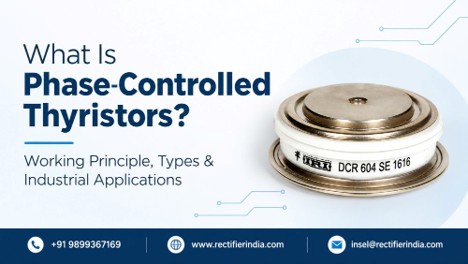
Power control in heavy industrial equipment rarely happens through a simple on-off switch anymore. Somewhere behind that smooth ramp-up on a motor drive or a furnace heating element, a thyristor is deciding how much of the AC waveform gets through. Insel Rectifiers builds a good chunk of what handles that job across Indian industrial installations, and this piece walks through what phase control thyristors actually do and where they show up.
What is a phase control thyristor?
A phase control thyristor is a semiconductor switch that conducts current only after receiving a gate trigger, and only during a specific portion of the AC waveform. A diode just lets current through whenever polarity allows. A thyristor waits for a signal. Delay that signal, and less of the wave gets through. Time it earlier, and more power flows.
How does a phase-controlled thyristor work?
Firing angle is the whole game here. Trigger the gate early in the AC half-cycle, and more of the waveform conducts, pushing more average power to the load. Wait longer, and that conduction window shrinks — less power reaches whatever’s downstream. Once triggered, the thyristor keeps conducting until current drops to zero at the end of the half-cycle. Needs triggering again after that, every cycle.
Types of phase-controlled thyristors
Package style changes how a thyristor handles heat and mechanical stress, which matters more than people expect once current ratings climb into industrial territory. Insel Rectifiers builds across both formats for exactly this reason.
Stud or flat type thyristors
A stud-type thyristor threads directly into a heat sink, similar to a stud diode. Good for moderate current applications with a compact single-point mount. Flat versions bolt against a surface instead, useful where a protruding stud doesn’t fit the enclosure.
Capsule type thyristors
A capsule thyristor sits compressed between two heat sinks under controlled clamping pressure, cooling from both sides at once. That double-sided cooling lets a capsule-type thyristor handle far higher current than a comparable stud package, which is why high-power rectifier bridges and HVDC applications lean on this format almost exclusively.
Where are phase control thyristors used?
Motor speed drives use them constantly, ramping torque up gradually instead of slamming a motor with full voltage at startup. Industrial heating elements rely on the same principle for temperature control. Large rectifier systems converting AC to DC at high power lean on phase-control thyristors as the switching element doing the conversion.
Why phase control thyristors matter
Smooth power control beats abrupt switching for equipment lifespan. A motor hit with full voltage instantly wears differently than one ramped up over a controlled window, and that difference compounds over years of daily starts. Thyristors make that gradual ramp possible at power levels a simple relay or contactor can’t handle cleanly.
Conclusion
Picking the right thyristor package comes down to current rating, cooling method, and available space. Insel Rectifiers manufactures both capsule and stud-type thyristor lines to cover that range, tested under real load rather than bench conditions alone. Reach out to Insel Rectifiers directly for a spec match before ordering for a new industrial build.
FAQs
What is the difference between a thyristor and a diode?
A diode conducts automatically whenever polarity allows. A thyristor needs a gate trigger first and stays off until it gets one.
What should I look for in a capsule thyristor manufacturer?
Clamping pressure specifications and thermal cycling test data matter more than the headline current rating alone.
Can a phase control thyristor be turned off manually?
Not directly through the gate. It turns off on its own once current drops to zero at the end of the conduction cycle.
Which Type of Thyristor Is Better: Stud Type or Capsule Type?
Depends on current level. Stud type suits moderate loads; capsule type handles higher current thanks to double-sided cooling.
Are phase control thyristors safe for high-voltage industrial use?
Yes, when properly rated and installed with correct heat sinking and protection circuitry for the specific application.