
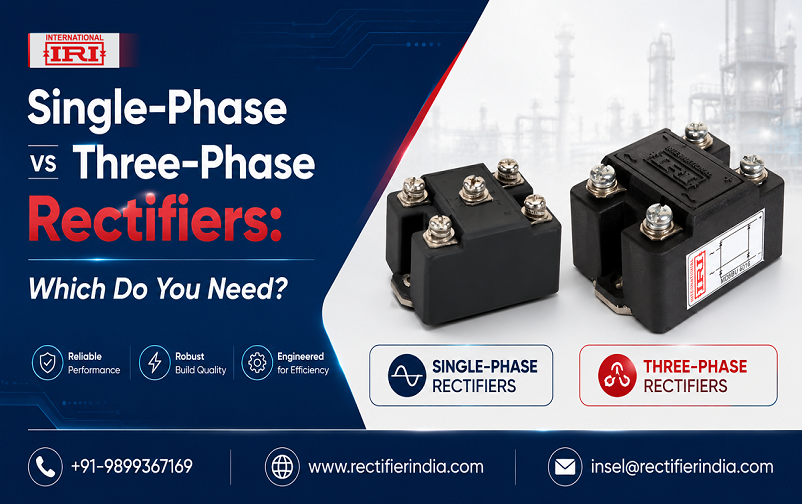
We at Insel Rectifiers are power conversion solution experts specializing in effective power conversion solutions. Rectifiers are very crucial in changing the AC (alternating current) to DC (direct current), which would be used to power the electronic devices, industrial systems, and machines used in automation. The decision between single-phase and three-phase rectifiers lies in your application, the requirements of your load, and what you expect of your performance.
Single-Phase Rectifiers: Design, Operation, and Performance
Also referred to as single-phase systems are mainly applied in residential and small-scale commercial applications.
Half-Wave and Full-Wave Single-Phase Rectifier Configurations
The solutions that we offer include a single-phase diode bridge rectifier and a single-phase full-wave bridge rectifier, which are more efficient solutions that deal with AC input and DC output, respectively. Full-wave drives offer superior performance to half-wave systems and more refined output as well.
Output Characteristics and Ripple Factor Analysis
The ripple content of single-phase rectifiers is usually greater. Our developed single-phase bridge rectifier solutions, however, were developed to reduce fluctuations and enhance the stability of the output.
Efficiency Ratings and Power Quality Considerations
Although single-phase systems are inexpensive, they are only suitable in low and medium-power systems because of their efficiency and power handling problems.
Three-Phase Rectifiers: Advanced Power Conversion Systems
Insel Rectifiers offers high power systems and industrial applications that require high power, that uses three phase bridge rectifier Systems. These are the three-phase diode bridge rectifier and the three-phase full-wave rectifier, which have a better efficiency, less ripple, and also better uniformity.
Three-phase rectifiers – excellent to use in cases where the operation being taken up is very heavy and needs the performance of the rectifier to be very stable and capable of very high levels of power conversion.
Comparing Performance: Single Phase vs Three Phase Systems
Power Output Capacity and Current Handling Capabilities
Three-phase systems can easily carry heavier loads, and the single-phase rectifiers can be used in much lighter applications.
Voltage Regulation and Stability Under Load Variations
Compared to single-phase systems, our three-stage full-wave rectifier systems are more stable and have better voltage regulation.
Cost Analysis: Initial Investment vs Long-term Operating Expenses
Single-phase rectifiers are cheaper in the short-term, though three-phase systems are more efficient over the long-term, and have lower operation losses.
Application Guidelines: Selecting the Right Rectifier Type
Residential and Small commercial applications in single-phase.
In smaller systems, Insel Rectifiers suggests the use of a single-phase full-wave bridge rectifier to have dependable and cost-effective operation.
Heavy Duty and Industrial Requirements for Three-Phase.
In the case of industrial applications, our three-phase diode bridge rectifier will be able to sustain the durability, efficiency, and high output capacity.
Special Considerations for Motor Drives and Variable Speed Applications
Reasons as to why three-phase rectifiers are favored in motor drives and automation systems can be contributed by the smooth DC output offered by three-phase rectifiers as compared to the irregular outputs commonly seen in the DC component of single-phase motors.
Summary
At Insel Rectifiers, we assist you in making the right choice depending on your power requirements. Although single-phase rectifiers could be best used with simple applications, three-phase systems could be used with better performance for industrial use. To maximize efficiency, reliability, and cost savings in the long run, it is essential to select the appropriate rectifier.
Frequently Asked Questions (FAQs)
1. Can I use a single-phase rectifier for high-power applications?
It is not recommended, as single-phase systems have limited power handling capacity.
2. What are the main cost differences between single-phase and three-phase rectifier systems?
Single-phase systems are cheaper initially, while three-phase systems offer better efficiency over time.
3. How do I determine the power requirements for my rectifier application?
You should evaluate load demand, voltage levels, and application type before selecting a rectifier.
4. Are there any safety considerations specific to three-phase rectifier installations?
Yes, proper grounding, insulation, and professional installation are essential.
5. Can three-phase rectifiers operate on single-phase power supplies?
No, they are specifically designed for three-phase input systems.
6. What maintenance requirements should I expect for each rectifier type?
Regular inspection, cleaning, and checking connections ensure long-term performance for both types.