
Build a power supply circuit, even something basic, and Rectifiers show up pretty quickly. They’re doing one job really — turning AC into DC — but the way that job gets done changes a lot downstream. Ripple, how efficient things end up, what parts cost. Get it wrong, and it’s not the end of the world, just means going back and redoing it once the output on a scope looks worse than hoped.
What is a Rectifiers?
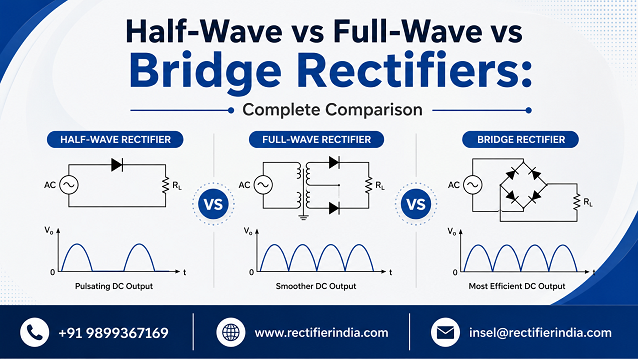
Basically, a circuit using diodes to convert AC into DC, letting current through one way and blocking it the other. Sounds simple, and mostly is. Where half-wave, full-wave, and bridge Rectifiers actually differ is in diode count and how each one deals with the AC waveform coming in.
Types of Rectifiers
Half-Wave Rectifiers
One diode does the whole job here. Passes one half of the AC cycle, blocks the other half completely. Cheapest option by far, easiest to wire up, but you’re throwing away half the input every single cycle, so output’s rough.
Full Wave Rectifiers
Two diodes this time, paired with a center-tapped transformer, and now both halves of the AC cycle get used instead of being wasted. Smoother output than half wave rectifers, noticeably better efficiency. The downside is that the center-tapped transformer is bulkier and costs more.
Bridge Rectifiers
Four diodes arranged in a bridge setup. Both halves of the AC cycle get converted; no center-tapped transformer is needed at all. This is why it’s become the default in most modern power supplies.
Half Wave vs Full Wave vs Bridge Rectifiers — Comparison, Advantages & Disadvantages
Half wave’s cheap and dead simple, but inefficient — high ripple, poor use of the transformer. Full wave fixes a lot of that, better efficiency, lower ripple, except now there’s a center-tapped transformer adding cost and bulk. Bridge Rectifiers basically match full wave on efficiency while skipping the center tap, so more compact and cheaper overall, though four diodes instead of two does mean a bit more voltage drop.
Applications of Half Wave, Full Wave & Bridge Rectifiers
Half-wave tends to show up in low-power stuff, basic signal demodulation, nothing demanding. Full waves are more common in older power supply designs, and some audio gear, too. Bridge Rectifiers are everywhere now, with phone chargers, computer PSUs, industrial setups, anywhere compact and efficient AC-to-DC conversion actually matters.
How to Choose the Right Rectifiers?
If cost matters more than efficiency and the load’s small, half wave bridge rectifiers is fine. Need something reliable that doesn’t waste space or power, bridge Rectifiers usually beat full wave, mostly because that center-tapped transformer requirement just isn’t there anymore.
FAQs
What is the difference between a full-wave and a bridge Rectifiers?
A full wave needs a center-tapped transformer plus two diodes. Bridge skips the center tap, uses four diodes instead, and ends up more compact.
Why is a bridge Rectifiers more efficient?
Uses the entire AC waveform without needing that center-tapped transformer, so less loss and better overall power use.
Which Rectifiers is used in power supplies?
Bridge Rectifiers, mostly, since they’re more efficient and cheaper component-wise than full-wave setups.
Can a bridge Rectifiers work without a transformer?
Yes, it’ll run straight off AC without one, though a transformer often gets added anyway for stepping voltage down or isolation purposes.